What Buyers Should Know About Checking samples for product consistency
A sample comparison can reveal differences in finish, dimensions, color, construction, and function, but only when the samples are identified and evaluated under consistent conditions. Buyers should distinguish a hand-selected approval sample from production output and decide how many units and batches are needed to assess variation rather than judging one attractive piece.
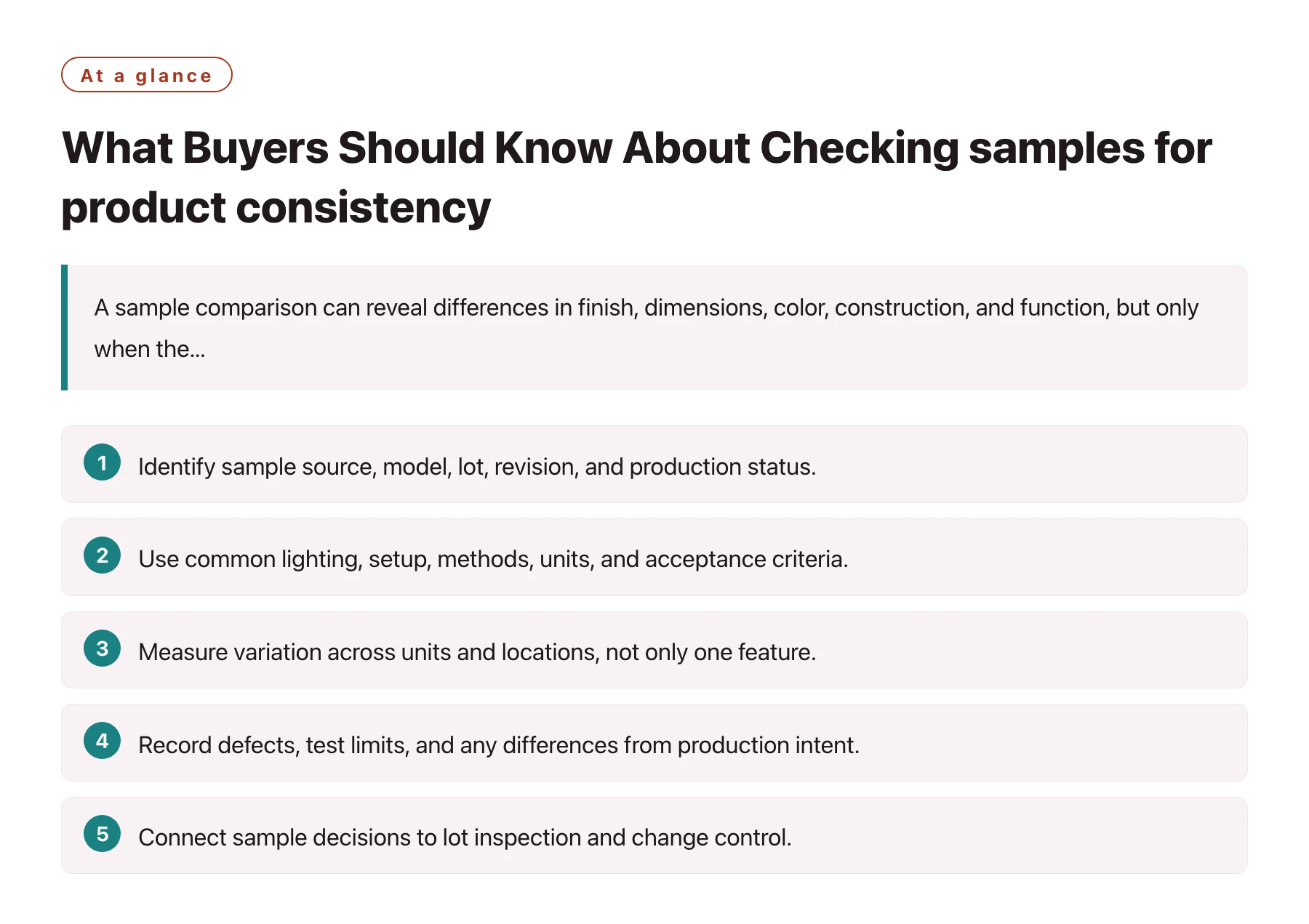
Key takeaways
- Identify sample source, model, lot, revision, and production status.
- Use common lighting, setup, methods, units, and acceptance criteria.
- Measure variation across units and locations, not only one feature.
- Record defects, test limits, and any differences from production intent.
- Connect sample decisions to lot inspection and change control.
Consistency is a distribution across units and batches; a single sample can show a feature but cannot establish process stability.
1. Decide which consistency question matters
Clarify whether the buyer is comparing suppliers, approving design appearance, verifying dimensions, reviewing function, or checking variation within production. Identify the product characteristics that matter: color, gloss, texture, thickness, length, fit, composition, strength, or package condition.
Rank critical features by impact and define acceptable range or reference. A sample that is visually similar may still differ in thickness or performance; a measured value may also vary with method, surface condition, or instrument. Involve technical owners when acceptance affects safety or installation.
2. Identify every sample before comparison
Label each sample with supplier, factory, product code, revision, material, lot, date, process status, and who selected it. Mark whether it is prototype, hand-finished showroom sample, first-off, production-intent, or randomly selected from a normal lot.
Record the quote and specification version associated with each unit. Ask whether samples were made with the planned materials, tooling, process, finish, and packaging. A polished sample made separately can set appearance expectations without representing normal batch output.
3. Standardize evaluation conditions
Use the same lighting, viewing distance, orientation, temperature, conditioning, cleaning, fixture, load, and operator actions for each candidate where relevant. State the instrument, calibration status, units, and measurement location. Take repeat readings if the method requires it.
For materials affected by moisture, ambient conditions, or surface preparation, record those conditions. Avoid comparing one sample straight from storage with another after conditioning. Write the setup so another reviewer can reproduce the evaluation.
4. Compare visual characteristics systematically
Place items side by side against an approved reference and assess color, gloss, grain, weave, finish, edge, print, and visible workmanship. Use a predefined rating scale or defect list instead of an undocumented impression. Photograph under the agreed conditions with a neutral reference when possible.
Review consistency across the face, edge, corners, and multiple areas. Record acceptable natural variation separately from defects such as scratches, chips, stains, bubbles, misalignment, or uneven coating. A sample board can help communicate appearance limits but may not capture every production condition.
5. Measure dimensions and fit across units
Choose critical dimensions and locations before measuring. Record nominal value, tolerance, instrument, unit, reading, sample identity, and whether the piece was conditioned. Measure multiple positions when variation across a panel, tile, profile, or assembly can affect installation.
Use the same datum and method across suppliers. Check mating parts, holes, edges, thickness, flatness, and interface dimensions where relevant. A pass at one location does not establish the whole item’s conformity; define sample quantity and distribution across the lot.
6. Evaluate functional or material performance
If function matters, define test setup, load, duration, cycle, user action, environment, and acceptance limits. Use a qualified laboratory or specialist for properties requiring controlled testing. Keep destructive tests separate from retained reference samples.
Review material certificates and reports against the exact product, source, revision, and test method. A certificate may confirm identity or a stated result but not all performance in the buyer’s installation. Document which properties were not evaluated.
7. Assess variation across batches and process time
When consistency over production matters, compare samples from multiple batches, production dates, shifts, or relevant lines. Identify whether variation comes from material source, tooling, finish, operator, curing, storage, or measurement. A single approval unit cannot reveal time-based drift.
Use a planned selection method rather than asking the factory to choose only its best units. For attribute-based lot decisions, ISO 2859-1:2026 describes AQL-indexed sampling procedures when the standard’s scope and contract use are appropriate; it does not guarantee defect-free output or process stability. [1]
8. Record defects and make a balanced decision
Create a comparison table with feature, criterion, supplier, sample ID, result, variation, defect, evidence, and reviewer. Separate mandatory requirements from preferences and note uncertainty. Use photos, measurement sheets, test reports, and retained samples to support the decision.
Avoid averaging away a critical failure. A sample set can meet average dimensions while some units exceed tolerance. Evaluate the distribution and defect severity in the way specified by the acceptance plan, and route safety, compliance, or structural questions to qualified owners.
9. Connect approved samples to production controls
Keep a sealed or controlled reference sample with labels and date. State whether it represents appearance, dimensions, function, material, packaging, or all of these. Attach the approval to drawing revision and purchase order. Define when new approval is needed after a material, supplier, process, site, or finish change.
During production, verify that current output remains consistent with the approved reference and specification. Use lot records and inspection results to assess ongoing control. Sample approval should not be treated as a one-time substitute for agreed production checks.
10. Close differences and update sourcing decisions
If suppliers differ, ask whether the cause is product design, process capability, material, measurement, or sample preparation. Resolve specification interpretation before placing volume orders. For a nonconforming sample, record disposition, correction, replacement, and any repeated evaluation.
Buyers checking JS Sourcing can connect sample evidence to supplier selection and building material acceptance criteria. After receipt, compare delivered lots with the approved sample and investigate variation against the same identity, method, and record trail.
Sources
Frequently asked questions
Can one sample prove a supplier makes consistent products?
No. It shows one unit under stated conditions; assess multiple representative units or lots to evaluate variation.
Should every sample be measured the same way?
Yes. Use common datums, instruments, units, conditions, and locations for comparable results.
Does an approved sample replace production inspection?
No. It is a reference for specified features; production controls and lot checks remain separate.
How should sample differences be resolved?
Identify the feature and method, confirm the specification, assess cause, and document an approved correction or deviation.