Bottle Decoration Compliance: Documents Buyers Should Collect
Compliance paperwork is collected in the wrong order more often than it is missing. Buyers tend to gather documents before a shipment, when the decoration is already fixed and the only remaining options are expensive. The file should be assembled during design freeze instead, when a change to an ink, a coating or an artwork costs a conversation rather than a rework. Most of what a decorated fragrance pack needs comes from four sources: the fragrance house, the manufacturer, the decorator and the brand's own market representative. Knowing which of them issues what is the whole exercise.
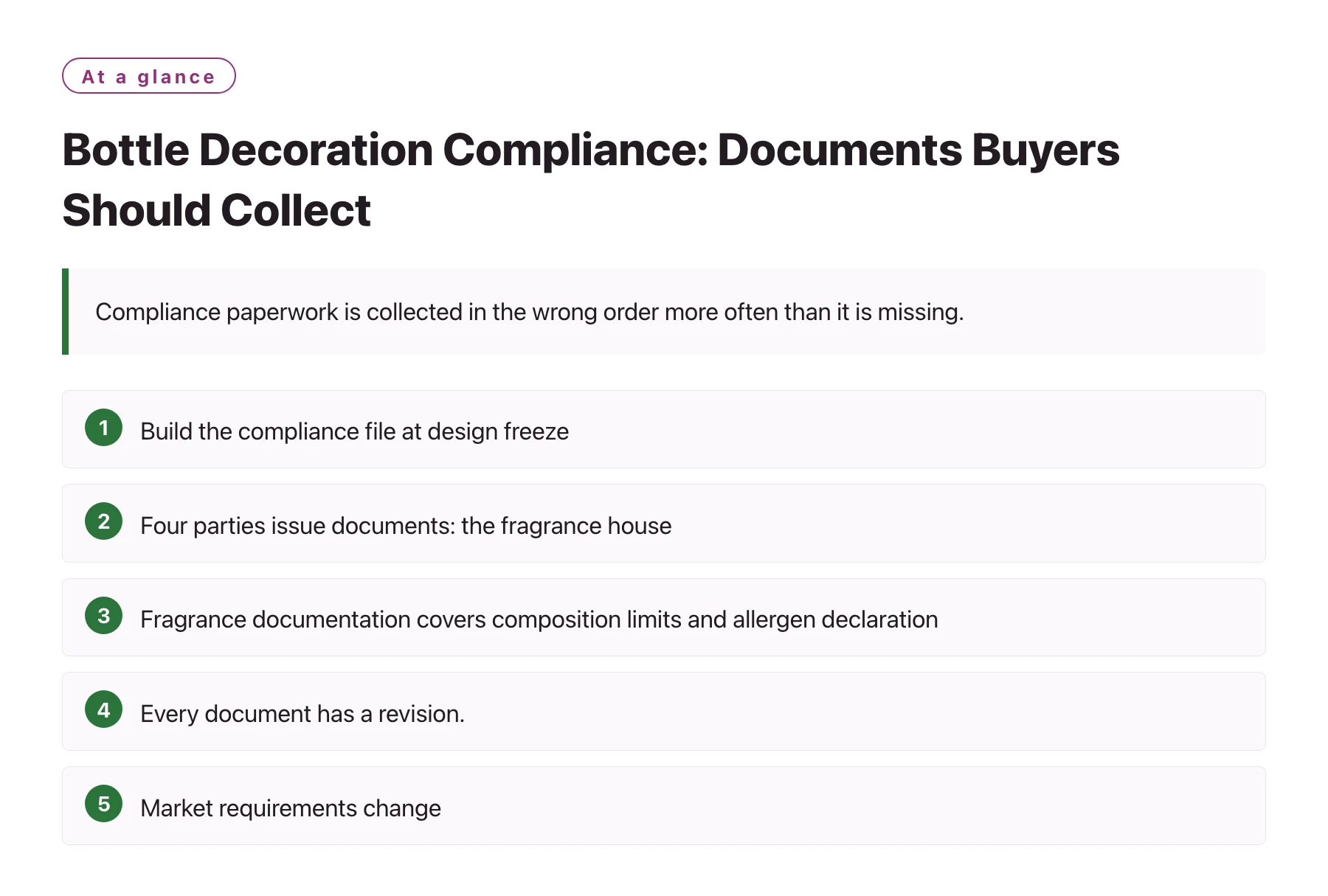
Key takeawaysBuild the compliance file at design freeze, not at shipping, because that is the last point at which decoration and artwork changes are still cheap. · Four parties issue documents: the fragrance house, the manufacturer, the decorator and the brand or its responsible person in each market. · Fragrance documentation covers composition limits and allergen declaration; packaging documentation covers recovery and material claims; artwork documentation covers mandatory information. · Every document has a revision. A file with two versions of the same declaration in circulation is a file that will fail an audit. · Market requirements change, so the file should be reviewed on a schedule and not only when a shipment is blocked.
Decoration sits at the intersection of two compliance systems that are usually managed separately: the cosmetic product rules that govern what is inside and on the pack, and the packaging rules that govern the materials and their end of life. A decorated bottle is subject to both, and the buyer is the only party who sees the whole picture.
This is not legal advice, and the requirements differ by market. What follows is an operations view: which documents exist, who produces them, and how to keep them from turning into a last-minute scramble.
It is written for teams that ship into more than one market and have learned that a single master file does not survive a second destination.
Why the document list belongs in the design brief
A decoration decision has documentation consequences. Choose a foil and you may need a statement about its composition. Choose a coating and you may need to explain how the component behaves at end of life. Choose a coloured glass and you may need a shade tolerance that is documented rather than assumed.
Putting the document list in the brief changes the order of work. The decorator is told which statements will be required before the method is finalised, and the brand learns early whether a market will accept the finish it wants.
Who issues what
The fragrance house issues the composition declaration and the conformity statement against the current IFRA Standards. The manufacturer issues batch records, certificates of analysis and process documentation, and supplies the data that feeds the finished product safety assessment. The decorator issues durability test results and, where relevant, material statements about inks, foils and coatings. The brand, or the responsible person it appoints in each market, holds the finished product file and the artwork record.
Why the brand cannot delegate the last step
In the EU, a cosmetic product needs a responsible person established in the market and a product information file that can be made available to the competent authority [1]. A manufacturer can prepare the inputs, and a good one does, but the obligation attaches to the product placed on the market. Brands that assume the factory holds the whole file discover the gap at the worst time.
The documents a decorated fragrance pack generates
| Document | Issued by | Needed when |
|---|---|---|
| Fragrance conformity statement | Fragrance house | At formula freeze, per revision |
| Allergen declaration | Fragrance house | At formula freeze and per labelling change |
| Certificate of analysis | Manufacturer | Per bulk batch |
| Batch record | Manufacturer | Per run; available for audit |
| Safety assessment inputs | Manufacturer and fragrance house | Before the product is placed on the market |
| Product information file | Brand or responsible person | Before the product is placed on the market |
| Decoration durability test report | Decorator | Per method and artwork |
| Packaging material and recovery statement | Packaging supplier and manufacturer | At design freeze and per market |
| Artwork revision record | Brand with decorator | At every artwork change |
| Transport documentation | Shipper | Per shipment |
Two rows in this table are routinely overlooked: the artwork revision record and the packaging recovery statement. Both are cheap to produce during design and expensive to reconstruct afterwards.
The compliance questions that touch decoration specifically
Most decoration compliance work comes down to three questions, and each one has an owner you can name.
Can the pack be recovered?
European packaging rules have been moving toward design-for-recycling and recycled-content requirements, which makes decoration and pack construction a single assessment rather than two [2]. In practice, this means knowing what proportion of the component is coated, how the ink or foil behaves in the recycling stream, and whether the cap and pump separate easily. If a market you sell into is tightening its rules, the decoration method is the cheapest thing to change and the hardest to change late.
Is anything migrating from the pack into the product?
Inks, coatings and adhesives on a pack that holds an alcohol-based product sit in continuous contact with a solvent. The safety assessment has to consider what could migrate, and the scientific opinions published by the EU's Scientific Committee on Consumer Safety are a standard reference point for how such questions are framed [3]. A decorator who has been asked this before will have test data; one who has not will need time to produce it.
Does the artwork carry everything it must?
Mandatory information on a fragrance pack is a labelling matter, and decoration is how it gets onto the bottle. Any artwork change, including a colour change that alters contrast, can affect legibility. Keep a checklist for each market, and treat a decoration revision as a labelling revision so the two cannot drift apart. Where the bottle, the decoration and the filling come from one operation, as with a contract manufacturer for perfume brands such as Xuelei China, the artwork record and the batch record live in the same system, which removes the most common source of version confusion.
Testing sits behind several of these documents. The kind of safety testing in perfume manufacturing that covers stability, compatibility and specific migration is carried out by laboratories working to defined methods, and their reports are what an importer asks for later [4].
One file, one index. Keep a single contents page listing every document, its revision, its issue date and who holds the original. When an importer or an auditor asks for something, the index is the difference between a five-minute reply and a week of email archaeology.
Keeping the file current without rebuilding it
Two habits keep a compliance file usable. The first is version control: every declaration carries a revision number and a date, and superseded versions are archived rather than left in circulation. The second is a scheduled review, at least once a year, timed so that a rule change does not arrive in the same week as a shipment.
It also helps to treat the file as part of the product rather than part of the order. Products that stay on the market for years accumulate labelling updates, packaging changes and reformulations, and each one touches the same documents. The teams that manage this well are the ones that never had to stop a shipment to do it.
If the file is being assembled for the first time, start with the two documents that everything else depends on: the frozen formula revision and the frozen artwork revision. From those, the rest of the list can be worked through in any order.
Sources
- European Commission: Cosmetics in the EU —— The European Commission's overview of EU cosmetics rules, including the responsible person, product information file and safety report requirements.
- European Commission: Packaging Waste and the PPWR —— EU rules on packaging and packaging waste, including the Packaging and Packaging Waste Regulation requirements on recyclability and design.
- EU Scientific Committee on Consumer Safety (SCCS) —— The EU scientific committee that issues opinions on the safety of cosmetic ingredients, including fragrance allergens and their labelling thresholds.
- SGS: Cosmetics, Personal Care & Household Testing —— Testing, inspection and certification services for cosmetics and personal care, including microbiological, stability and safety testing aligned with cosmetics GMP.
Frequently asked questions
Who is responsible for compliance, the brand or the factory?
The obligation to place a compliant product on the market belongs to the brand or its appointed responsible person in that market. The factory supplies the inputs: batch data, certificates, conformity statements and test reports. Confusing the two roles is the most common cause of a late scramble.
Do I need separate documents for each market?
Usually yes, at least in part. Fragrance composition limits, labelling requirements and packaging rules differ, so a single master file will not serve every destination. Keep one master and a short market-specific addendum per destination.
How long should compliance documents be retained?
Retention periods are set by market rules and by your own commercial policy. The practical approach is to retain everything for as long as the product could still be on a shelf, plus the period your market requires.
Does decoration really affect compliance, or is it only the fragrance?
It affects compliance in three ways: artwork legibility, pack recovery, and the possibility of migration from inks and coatings into the product. All three are decoration decisions, and all three are easier to satisfy if they are raised at design freeze.
What is the single most useful document to have ready first?
The frozen artwork revision, with its date and revision number, because it connects the decoration, the labelling and the batch records. Without it, the rest of the file cannot be tied to a specific version of the product.